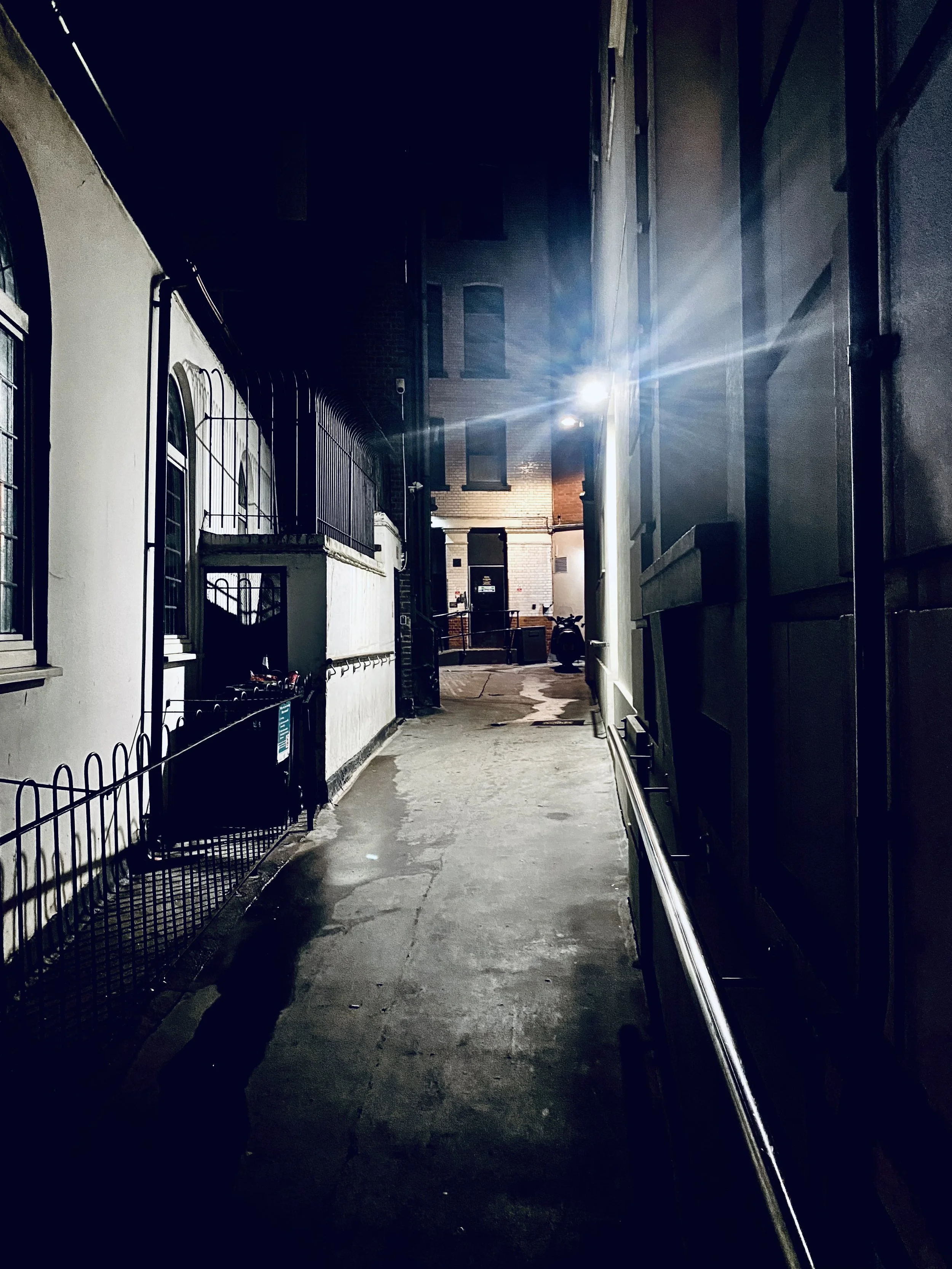
TAKE A LOOK at the photograph above. Imagine walking along this alleyway. How would you feel?
This is what architects call a ‘liminal’ space, from the Latin word limen, which means threshold. It’s one of those neither here nor there places, an in-between space - a route from one place to another. If the thought of walking through this space makes you feel uncomfortable, or even anxious, you’re not alone. People don’t hang around in liminal spaces - they get through them as fast as possible.
It is precisely because of the emotions conjured up by these transitional spaces that a liminal photography movement has emerged in the past few decades. Consider, for instance, the work of American photographer Todd Hido. His photographs explore the relationship between memory, solitude, and the psychological tension of everyday environments. Hido’s photographs may appear bleak to you, but his work is in museums and galleries all over the world. Clearly, some are attracted to liminal spaces.
Anyway, I was driving across a corner of Surrey, between the M25 and the M23 above Redhill, thinking about turning liminal spaces into a photographic project of my own, when an idea occurred to me: “What we need right now is more liminal thinking.”
As a rule, people (and I include world leaders in that description) live in ideological bubbles generated by their genetics, their experiences, their influences, beliefs and values. Liminal thinking would require them to step out of those bubbles into admittedly less comfortable spaces where they could look back at their values and beliefs from a different point of view, and peer forward into the often contrary beliefs of others. It’s in the liminal spaces that real insight exists.
When I got home, I searched for the term ‘Liminal Thinking’ and discovered it was already the title of a book by an American author, Dave Gray. Its subtitle is “Create the change you want by changing the way you think.” Sigh - as Bob Dylan once sang: “… if there’s an original thought out there, I could use it right now.” Still, Gray’s book has value and it is supported by a pretty good website.
Whatever else, it’s a useful exercise to try and step outside of one’s own ideological bubble for a while, if only to get a different perspective on beliefs and values one probably hasn’t really challenged in decades. What we believed at 24 may need reviewing at 42, and again at 62.
This doesn’t only apply to individuals: entire nations seem to live in ideological bubbles too. I was recently asked to write something about a new hotel in Kuwait, and in the process of doing the research I had to revisit The Golden Age of Islam when Baghdad was a world-class centre for ideas and education; a marvellous period for mathematics, science, architecture, arts, literature and exploration. Why had this not been taught at my school? Why had the school not included the history of Baghdad alongside those of Greece and Rome? Was there a rule that all of our heroes had to be European, or Christian?
Equally, it’s only very recently, that western media has - somewhat grudgingly it seems to me - recognised the technological breakthroughs made by China in the last decade. When the world is warming, what’s the big issue with celebrating another country’s breakthroughs in the production of alternative energy and electric cars?
Personally, I’ve always found liminal spaces fascinating: I like edgelands and thresholds, transitional spaces where new things - good and bad - might be discovered. Sticking only to the places and styles of thought where you feel comfortable is - to borrow a simile from nature writer Melissa Harrison - like only ever listening to music in a major key; you’re missing so much.
In a world of binary thinking, of us and them, of wars and rumours of wars, surely a little liminal thinking might be helpful - if profoundly challenging for those who already know they’re right.
The alleyway runs from Orange Street behind the National Gallery past two non-conformist churches before angling sharply left back on to St Martin’s Street and into Leicester Square. I wouldn’t recommend a stroll there after dark.